Why weighing your horse's hay matters more than counting flakes.
Ask a horse owner how much hay they feed, and one of the most common answers is, "Two flakes in the morning and two flakes at night." It sounds precise because the routine is consistent and everyone in the barn understands what a flake looks like. The problem is that a flake is not a standard unit of weight. Two flakes from one bale may contain considerably more hay than two flakes from another, even when the bales look nearly identical.
Penn State Extension recently showed just how much that difference can matter. In one example, flakes from one batch averaged around five pounds, while flakes from another averaged closer to seven pounds. A horse receiving five flakes per day could therefore be eating about 25 pounds from one batch or 35 pounds from the other. The feeding directions have not changed, but the horse is receiving an additional 10 pounds of forage every day. Penn State also weighed three flakes from the same bale and recorded weights of 4.57, 3.21, and 4.54 pounds, showing that meaningful variation can occur within a single bale.
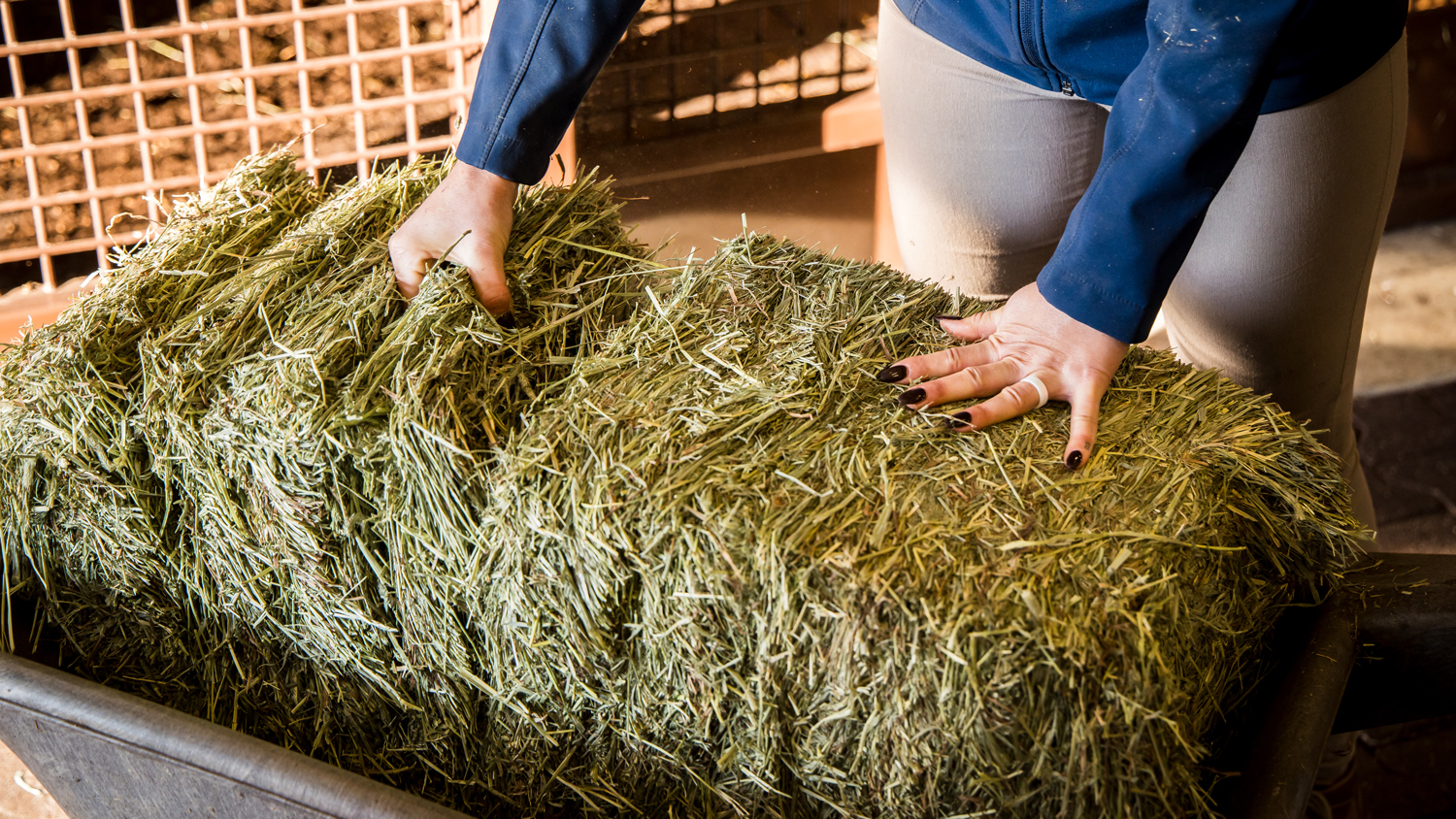
None of that means flakes are a bad way to handle hay. They are convenient, familiar, and one of the reasons square bales work so well in horse barns. It simply means that a flake is a section of a bale, not a nutritional serving. The dependable way to know how much forage it contains is to put it on a scale.
So, How Much Does a Flake of Hay Weigh?
There is no single answer. A flake, sometimes called a slice, is the layer that separates when a square bale is opened. It is created as successive charges of forage are gathered, compressed, and moved through the baling chamber. No nutritionist decides how many pounds should go into each flake, and there is no universal standard that makes one flake equal to another.
Flake thickness and density can change with windrow size, travel speed, crop moisture, bale tension, forage variety, and the design and adjustment of the baler. Modern baling systems pay close attention to flake formation, bale length, density, and finished bale weight because field conditions can change throughout the day. That is why "four flakes per day" may be a perfectly repeatable chore instruction while still being an inconsistent feeding measurement.
Different Forages Make Different Flakes
The forage itself also affects how a flake looks and feels. A leafy flake of alfalfa may be compact and heavy, while a stemmier grass flake may look larger but weigh less. Timothy, Orchard Grass, Alfalfa, Teff, Valley Grass, and mixed grass hay all have different plant structures, stem sizes, leaf content, and density. Maturity changes the bale too. As plants mature, they generally develop more stem and structural fiber and less leaf, changing both the nutritional profile and the physical character of the hay.
Visual size can therefore be misleading. A large, fluffy flake is not necessarily providing more forage than a smaller, denser one, just as a soft flake is not automatically more nutritious than a firm one. Weight tells you how much hay is being offered, while a forage analysis helps explain what that hay provides nutritionally. We explored the same principle in Not All Hay Is Created Equal, where two bales with very different price tags became much more comparable once weight and nutrient delivery were included.
The 3-Tie Baler Leaves Its Fingerprint
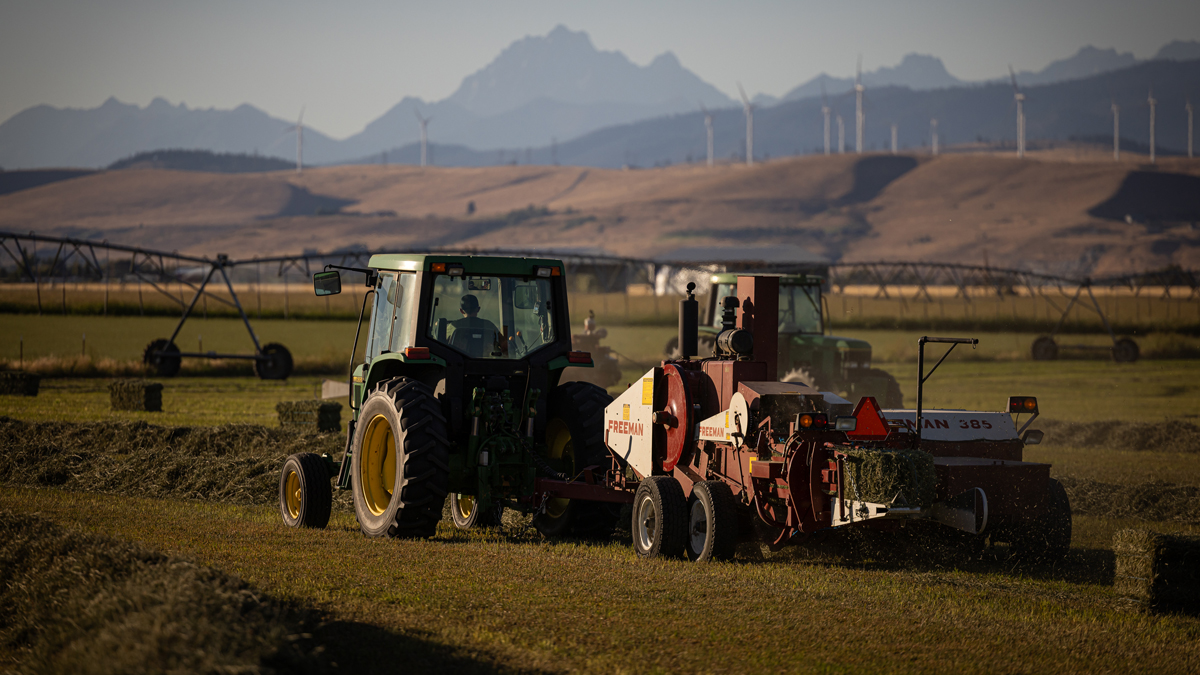
At Anderson Hay, we use both modern Massey Ferguson 3-tie balers and vintage Freeman 3-tie balers. Both produce the familiar 3-tie package used in many horse barns, but they form and move forage through the chamber differently. Modern Massey Ferguson 3-tie balers use inline crop flow and a precompression system that forms each slice before it enters the main bale chamber, helping create a well-shaped bale with consistent density. Freeman 3-tie balers use a heavy-duty side-feed design and are built to produce larger, heavier, reliably uniform bales whose size and density can be adjusted for the crop and market.
In our experience, many longtime horse-hay customers have a real appreciation for what they call a "Freeman flake." They like the substantial, square sections, the familiar way the bale breaks apart, and how well the package stacks and handles. That preference is understandable, but it does not make every Freeman flake a standard weight. Windrow size, crop density, travel speed, moisture, bale tension, and machine adjustment can still produce thicker or thinner sections. A well-formed flake is convenient to handle, but it is not a measuring cup.
Technology and equipment can improve bale formation and consistency, whether the forage is produced by a modern Massey Ferguson 3-tie baler or a vintage Freeman 3-tie baler. Hay is still a crop shaped by changing conditions, however, and some natural variation remains. The baler leaves its fingerprint on the package. The scale tells you how many pounds are actually in your hand.
3-Tie Flake and a Compressed Flake Are Not the Same
Bale format adds another variable. An Anderson 3-Tie Bale is formed directly in the field and averages about 90 pounds. Its flakes usually look larger because the bale remains at its full field-baled dimensions. An Anderson Compressed Bale commonly weighs about 50 pounds but occupies considerably less space because quality field bales, many of them 3-tie bales, are mechanically repressed into a more compact package. The hay is compressed for handling, storage, and transportation while retaining long-stem forage and the ability to separate into flakes.
A compressed flake may look much smaller than the flake someone is accustomed to pulling from a traditional 3-tie bale, but visual size does not tell us how many pounds it contains. Some customers open a compressed bale and worry that the flakes seem too small. Others feed the same number of flakes they previously used from a full-size bale and unknowingly change the horse's daily intake. Weighing answers both questions.
Our article Compressed vs. Traditional 3-Tie Hay: What's the Real Difference? explains why the package changes handling and storage, not the nutritional value of the forage inside. Quality still begins with the hay that came from the field.
Why a Few Pounds Can Matter
For many mature horses, about two percent of body weight in forage per day is a common planning point, although actual needs vary with body condition, workload, health, forage quality, pasture access, and the complete ration. For a 1,000-pound horse, two percent equals approximately 20 pounds of forage each day. University of Minnesota Extension notes that many horses willingly consume between two and two and a half percent of their body weight in hay when given free access.
Now consider what happens when an owner believes each flake weighs five pounds, but a new load contains seven-pound flakes. Four flakes would provide 28 pounds instead of the expected 20. For an easy keeper, that difference can add considerably more calories than intended. The reverse can happen with a hard keeper. If the flakes become lighter while the number stays the same, the horse may receive fewer pounds of forage and less total nutrition than the owner realizes.
Accuracy becomes especially important for horses on controlled feeding programs. Kentucky Equine Research advises owners managing horses with Equine Metabolic Syndrome to weigh hay rather than estimate visually or count flakes, because a calculated percentage of body weight only works when the amount offered is actually known. The scale does not replace watching the horse or working with a veterinarian or nutritionist. It gives everyone a dependable starting point.
Weighing Hay Does Not Have to Complicate Chores
Feeding by weight may sound like one more task in an already busy barn, but it does not need to slow anyone down. A filled hay net can be weighed with an inexpensive hanging or luggage scale. Loose flakes can be placed in a tote or trash can on a bathroom scale, with the container tared before adding the hay. Penn State recommends both methods as practical ways to replace a visual estimate with an actual weight.
You also do not need to weigh every meal forever. When a new load arrives, weigh several flakes from several bales and establish a working average. If the flakes average five pounds and your horse needs approximately 20 pounds per day, you have a practical starting point for dividing that forage among feedings. Recheck periodically and whenever you change forage variety, cutting, supplier, production lot, 3-tie baler type, or package format. That small habit preserves the convenience of feeding by flakes while keeping the ration based on pounds.
Watch: Why Feeding Hay by Weight Matters
Counting flakes is easy, but it does not always tell you how much forage your horse is receiving. In this short video, we demonstrate why flake weights can vary, how compressed and traditional flakes should be compared by weight rather than appearance, and how a simple scale can create a more measurable and consistent feeding routine.
As we explain in Feeding Horses Right, the goal is not to turn every meal into a laboratory exercise. It is to establish what your hay weighs, build a routine around that information, and check it again when something changes. Once you know the average weight of the flakes in front of you, daily feeding can remain simple, fast, and repeatable.
Consistency Starts With a Scale
At Anderson Hay, we put a tremendous amount of work into consistent 3-tie bale weights, clean flakes, product specifications, forage testing, and traceability. Modern Massey Ferguson 3-tie balers help produce well-formed bales, while vintage Freeman 3-tie balers continue making the familiar package and flake many horse-hay customers appreciate. Even with that care, flakes remain sections formed from a natural crop by a mechanical process.
Consistent hay gives you a dependable starting point. Weighing tells you what you are actually feeding. The next time someone asks how much hay your horse receives, "four flakes" may still be the easiest way to describe the chore. The more useful answer is the number of pounds those flakes represent. That one measurement makes it easier to compare forage varieties, bale formats, and new loads, follow a nutrition plan, monitor body condition, and keep the ration consistent when something changes.
A flake is a convenient way to divide hay. It simply is not a measurement. Weigh the hay, watch the horse, and adjust the feeding program based on the animal and forage in front of you.
Research and Further Reading
- The Importance of Weighing Horse Feed, Penn State Extension
- Using Hay in Horse Diets, University of Minnesota Extension
- Four Research-Based Tips for Feeding Horses with EMS, Kentucky Equine Research
- Massey Ferguson 1800 Series Small Square Balers
- Freeman 3-Tie Side-Feed Balers, Allied Systems
- Not All Hay Is Created Equal, Anderson Journal
- Compressed vs. Traditional 3-Tie Hay, Anderson Journal
- Feeding Horses Right, Anderson Journal
- What to Feed Horses with Metabolic Issues, Anderson Journal
Frequently Asked Questions
How much does a flake of hay weigh?
There is no standard weight for a flake of hay. A flake may weigh three pounds, five pounds, seven pounds, or more depending on the forage, bale density, baler settings, and how the bale separates. Penn State Extension weighed three flakes from the same bale at 3.21, 4.54, and 4.57 pounds, showing that flake weight can vary even within one bale.
Why do hay flakes vary in weight?
A flake is simply a section formed as forage moves through the baler. Its weight can be influenced by forage variety, plant maturity, leaf and stem content, crop moisture, windrow size, bale density, tension settings, travel speed, and the amount of hay entering the chamber. This means a large, fluffy flake may weigh less than a smaller, denser one.
Can flakes from the same bale weigh different amounts?
Yes. Flakes from the same bale can differ in thickness, density, and weight because the amount of forage entering the baler may change as it moves through the field. Penn State's example found more than a one pound difference among three flakes taken from one bale.
How many flakes of hay should a horse eat each day?
There is no dependable number of flakes that is right for every horse. Begin by determining how many pounds of forage the horse needs, then weigh the flakes to learn how many are required to reach that amount. The correct ration depends on the horse's body weight, condition, workload, health, forage quality, pasture access, and complete diet.
How much hay should a 1,000-pound horse eat each day?
About two percent of body weight is a practical starting point for many mature horses. For a 1,000-pound horse, that equals approximately 20 pounds of hay per day when hay is the primary forage source. Some horses may need more or less depending on body condition, workload, health, forage quality, pasture access, and the rest of the feeding program.
Should horse hay be measured by weight or by flakes?
Hay should be measured by weight when building a feeding program. Flakes remain a convenient way to divide and distribute hay after their average weight is known, but flake count alone does not tell you how many pounds the horse is receiving. Weighing helps prevent unintentional overfeeding or underfeeding when a new bale or load contains different sized flakes.
Do compressed hay flakes weigh less than 3-tie flakes?
Not necessarily. A compressed flake may look smaller because the hay is packaged at greater density, while a traditional 3-tie flake may appear larger because it retains its full field baled dimensions. Visual size does not reliably show weight, so flakes from both formats should be weighed rather than compared by appearance or count.
Can the type of 3-tie baler affect flake size and weight?
Yes. Different 3-tie balers use different crop flow, compression, and bale formation systems, and their settings can influence bale length, density, weight, and how the finished bale separates into flakes. Crop conditions and operator adjustments also matter, so even a clean, well-formed flake should not be treated as a standardized serving.
How can I weigh my horse's hay at home?
One simple method is to fill a hay net and weigh it with a hanging or luggage scale. Loose flakes can also be placed in a tote or trash can on a bathroom or platform scale. Tare the scale with the empty container in place, or subtract the container's weight from the final total.
Do I need to weigh every flake at every feeding?
Not necessarily. A practical approach is to weigh several flakes from several bales when a new load arrives and use those measurements to establish a working average. Recheck periodically and whenever you change forage variety, cutting, supplier, production lot, baler type, or bale format. Daily chores can still be organized by flakes once you know approximately how many pounds those flakes represent.
Why is weighing hay especially important for horses with metabolic concerns?
Controlled feeding plans are commonly based on a percentage of the horse's actual or ideal body weight. That calculation is only useful when the hay being offered is measured in pounds rather than estimated by appearance or flake count. Kentucky Equine Research specifically advises owners managing horses with Equine Metabolic Syndrome to weigh hay instead of eyeballing the amount or counting flakes.
Does weighing hay replace a forage analysis?
No. Weighing tells you how much forage the horse is receiving, while a forage analysis explains what that hay provides nutritionally. Protein, digestible energy, fiber, sugars, starch, and minerals can vary among fields, cuttings, and hay varieties. Using weight and analysis together provides a much clearer foundation for a consistent feeding program.