Compressed hay has become increasingly common for horse owners and livestock producers because it is easier to transport, stack, and store. Whether you are feeding horses, cattle, small ruminants, or other animals, forage quality is the foundation of animal health and performance. Still, many buyers hesitate when they see a compressed bale for the first time and wonder whether compression affects quality, nutrition, or fiber length.
These are fair questions. When forage is the primary component of a diet, small misunderstandings can turn into long-lasting myths. Let’s walk through the most common concerns and clarify what research and forage science actually tell us.
Myth 1: Compressed Hay is Lower Quality
The belief that compressed hay is lower quality often comes from confusing packaging with production. Hay quality is established in the field, not at the compression plant. Plant species, maturity at harvest, irrigation and fertility management, weather during curing, and proper storage practices determine nutritional value for both horses and livestock.
Compression occurs after harvest and curing. It increases density for efficient shipping and storage, but it does not change the chemical composition of the forage. In an article, "Horse Hay: Understanding Sugar and Starch Content", published by Kentucky Equine Research and guidance from the National Research Council confirm that nutrient levels are influenced by harvest timing and growing conditions rather than bale format.
At Anderson Hay, every stack is tested and documented before it is ever compressed. That process is explained in detail in our article, Traceability at Anderson Hay: From the Field to Your Barn
Quality begins in the field. Compression simply preserves what was already produced.
Myth 2: Compressed Hay is More Dusty
Dust is one of the most common concerns surrounding compressed hay, particularly for horse owners managing respiratory sensitivity, but dust is not created by compression. Dust typically results from overmature harvest, weather damage, leaf shatter, mold development, or improper moisture at baling. These same factors affect hay fed to cattle, goats, sheep, and other livestock.
University extension programs, including Penn State and the University of Kentucky, consistently identify harvest timing and storage conditions as the primary contributors to dusty forage. If hay is clean and properly cured before compression, it will remain clean afterward. If it is dusty before compression, it will remain dusty after.
Dust is a harvest and storage issue, not a packaging issue.
Myth 3: Compression Changes The Nutritional Value
Some producers worry that compressing hay reduces its nutritional value, but mechanical compression does not alter the inherent nutrients in properly cured forage. It simply increases bale density.
As long as hay is baled at safe moisture levels and protected from heat damage, crude protein, fiber fractions such as ADF and NDF, mineral content, and nonstructural carbohydrates remain stable. Established forage science shows that nutrient composition is determined by plant maturity and environmental conditions at harvest, not by the method of packaging.
When comparing bale types for horses or livestock, it is more helpful to review forage analysis than to focus on format. Our article Compressed vs Traditional 3-Tie Hay explains these differences in more detail.
Nutritional value is established before compression ever begins.
Myth 4: Compressed Hay Has Shorter Fiber Length
Fiber length matters for chewing behavior, rumination, and digestive health across species. For horses, adequate forage particle length supports saliva production and hindgut function. For ruminants such as cattle and goats, long fiber plays an important role in proper rumen activity.
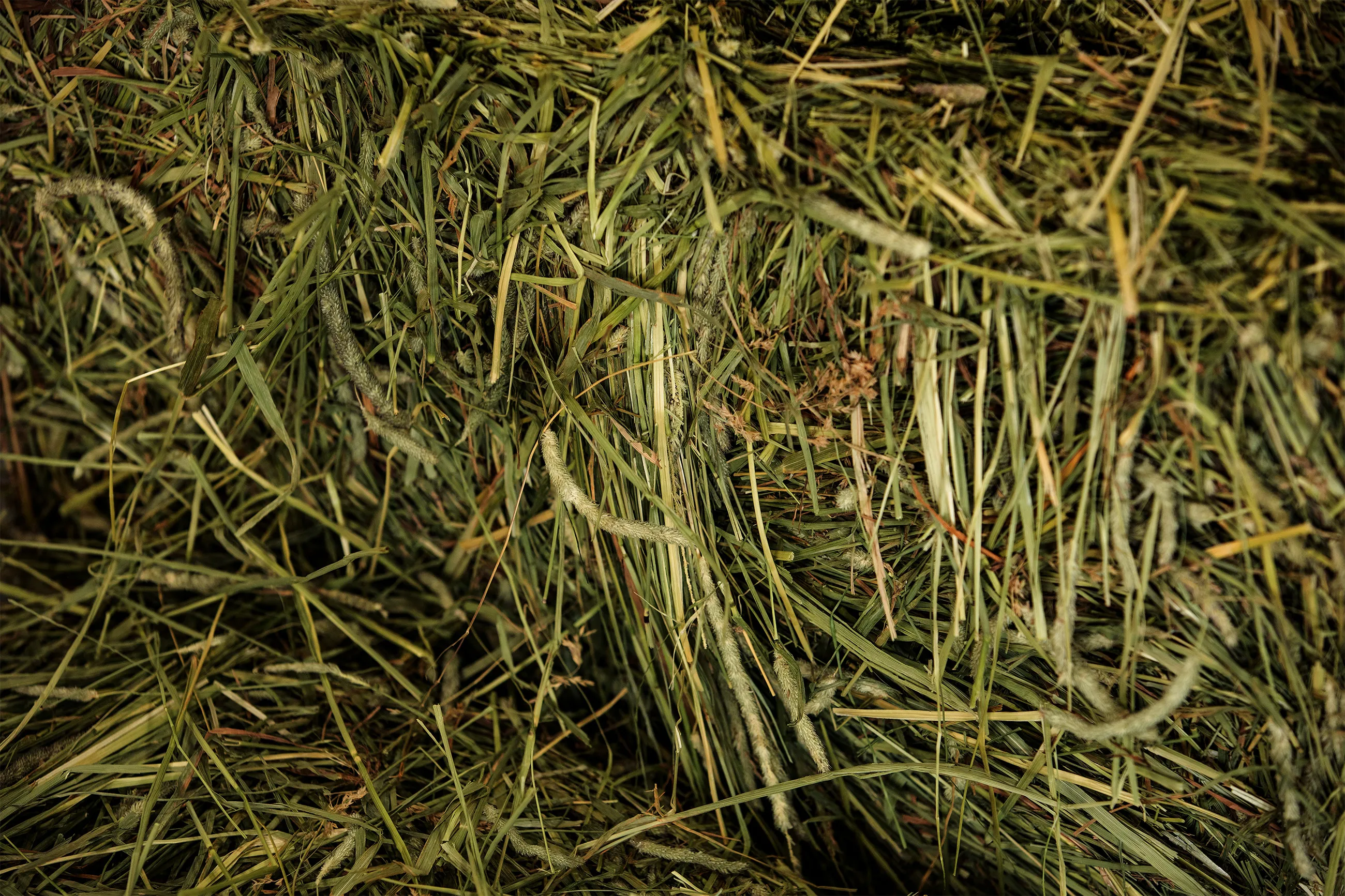
Fiber integrity depends on how the forage was harvested and handled before compression. Long-stem hay supports normal digestive function, and compression alone does not shorten fibers unless the forage has been mechanically chopped or ground prior to packaging.
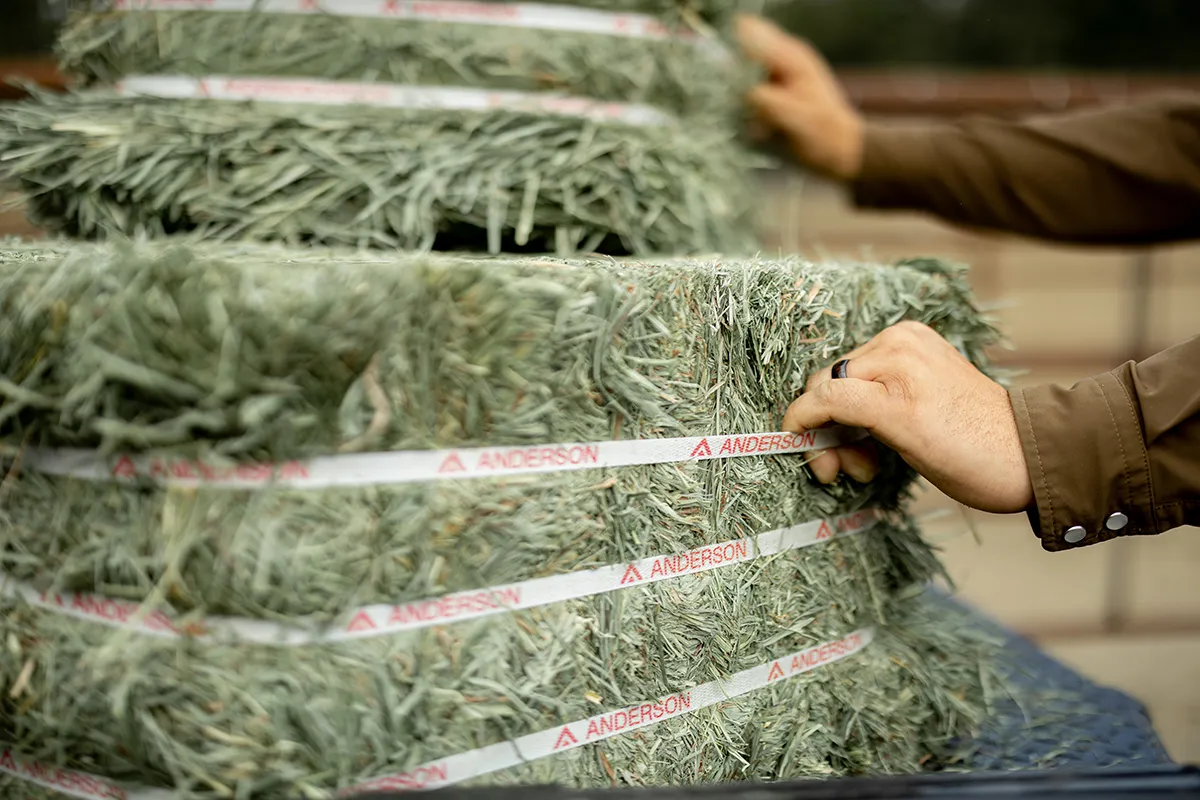
At Anderson Hay, many compressed bales begin as traditional 3-tie bales made from long-stem forage harvested at proper maturity. Because intact hay is compressed rather than mechanically reduced, stem structure and flakability are preserved.
Fiber length is determined at harvest, not during compression.
If you would like to see how Anderson compressed hay is produced, you can watch the process below.
Understanding how hay is made often removes much of the uncertainty.
Myth 5: All Compressed Hay is the Same
It is easy to assume that all compressed hay products are interchangeable, but the final product reflects the quality of the forage used to produce it. Forage value is established in the field through proper agronomic practices, responsible harvest timing, moisture control, and careful storage.
University forage research consistently reinforces that processing cannot improve inferior hay. Compression preserves what already exists. If high-quality forage is compressed, it remains high quality. If lower-quality forage is compressed, densification does not correct those deficiencies.
This is why testing, documentation, and consistency matter for both horse owners and livestock producers. When hay is grown, harvested, tested, and tracked carefully, customers can rely on predictable quality regardless of bale format.
Start with good hay. End with good hay.
The Bottom Line
Compressed hay is not inherently inferior, dusty, or nutritionally compromised. Its quality depends on how it was grown, harvested, tested, and stored. Compression is simply a method of packaging designed to improve efficiency and convenience.
For horse owners and livestock producers alike, the more important question is not whether the hay is compressed. The better question is how the hay was produced before it reached the bale.
When quality begins in the field and is supported by testing and traceability, bale format becomes a matter of convenience, not compromise.
Ready to Feed with Confidence?
Whether you choose traditional 3-tie or compressed bales, the most important factor is quality, consistency, and verified testing.
If you're looking for clean, tested, traceable forage you can trust, find Anderson Hay at a retailer near you.